

At Sanki, Cameroon, City of Ubuntu works in an area strongly characterised by savanna vegetation, shaped by the high temperatures typical of this locality in the Ndé Division. By planting cocoa in these conditions, City of Ubuntu is exploring some of the secrets of agroecology, which we are happy to share here.
Creating living spaces for humans, plants, and animals is a mission that City of Ubuntu pursues with conviction. In Sanki, one way we put this into practice is by growing cocoa without synthetic chemical inputs. It is sustainable cocoa farming, despite environmental conditions that might initially suggest otherwise.
A Savanna Landscape That Makes You Think of Somewhere Else
The area where City of Ubuntu works in Sanki is strongly characterised by savanna. Trees are scarce, and at first glance, the region may not seem suitable for growing cocoa, a shade-loving plant.
This is especially true because temperatures can become very high at certain times of the year. The challenge is compounded by the fact that streams are not always nearby and rainfall does not always follow the patterns experienced elsewhere in the Ndé Division.
With greater exposure to sunlight and strong winds, the soil is particularly vulnerable to erosion and drying out.
These environmental constraints often lead young people to look elsewhere for opportunities.
Yet City of Ubuntu also promotes rural entrepreneurship, recognising that its absence contributes to rural exodus and all the challenges that come with it. We lead by example. Growing cocoa in an area that initially appears unsuitable is an experience we can share with young people who abandon their land because of perceived ecological and climatic constraints.
This experience is still ongoing, and it has a secret that City of Ubuntu would like to share.
Agroecology: City of Ubuntu’s Secret to Growing Cocoa
Agroecology is the secret that enables City of Ubuntu to grow cocoa in this savanna area.
The first principle we follow in Sanki is to avoid cutting down the few savanna trees that remain. As Jean de Dieu Tagne puts it:
“For every tree you cut down, plant two.”
Another important measure is digging planting holes that help retain water, which is useful for irrigating young plants.
Most importantly, whenever we plant young cocoa trees, we do so next to young plantain banana plants that have already been planted.
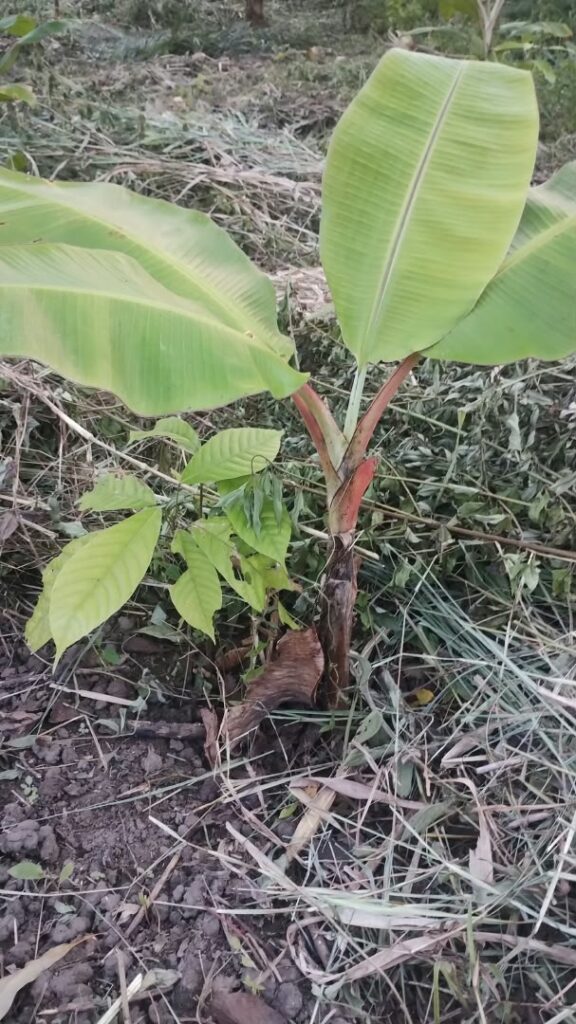
Plantain Bananas Provide Shade for Young Cocoa Trees
This approach provides the young cocoa plants with temporary shade, which they greatly need.
Studies indicate that a lack of shade can result in losses of up to 40% among young cocoa plants. In addition, the presence of plantain bananas creates a favourable microclimate for the developing cocoa trees.
Along with helping maintain soil moisture, the banana plants offer some protection against the strong winds and excessive sunlight that Sanki experiences during the dry season.
However, plantain bananas grow faster than cocoa trees. Their new shoots can potentially suffocate or compete too strongly with the young cocoa plants, which develop more slowly.
For this reason, City of Ubuntu’s workers avoid planting cocoa and plantain bananas together in the same hole.
This is an intelligent form of crop association promoted by agroecology, which contributes to building a sustainable food system.
Through these practices, City of Ubuntu continues to explore how agroecology can make cocoa farming possible in challenging environmental conditions while respecting nature and creating opportunities for rural communities.